









International Seminar on SDEs and Related Topics
Schedule 2024 Autumn
Oct 18, 2024
Michael Röckner Poster: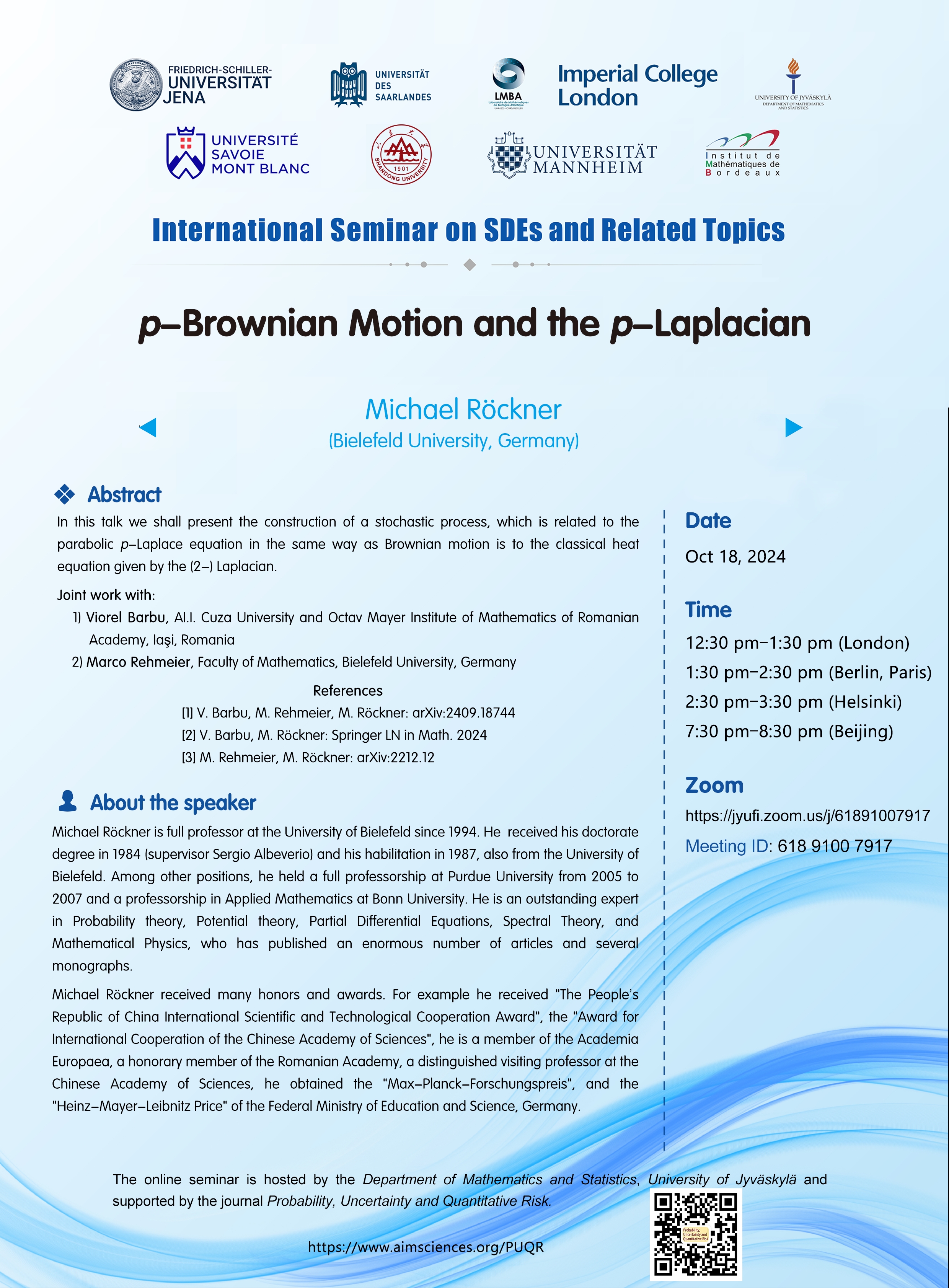 Slides
(Bielefeld University, Germany)
Abstract:
In this talk we shall present the construction of a stochastic process, which is related to the parabolic
p-Laplace equation in the same way as Brownian motion is to the classical heat equation given by the
(2-) Laplacian.
Joint work with:
1) Viorel Barbu, Al.I. Cuza University and Octav Mayer Institute of Mathematics of
Romanian Academy, Iaşi, Romania
2) Marco Rehmeier, Faculty of Mathematics, Bielefeld University, Germany
References
[1] V. Barbu, M. Rehmeier, M. Röckner: arXiv:2409.18744
[2] V. Barbu, M. Röckner: Springer LN in Math. 2024
[3] M. Rehmeier, M. Röckner: arXiv:2212.12
Nov 15, 2024
Mathias Beiglböck Poster: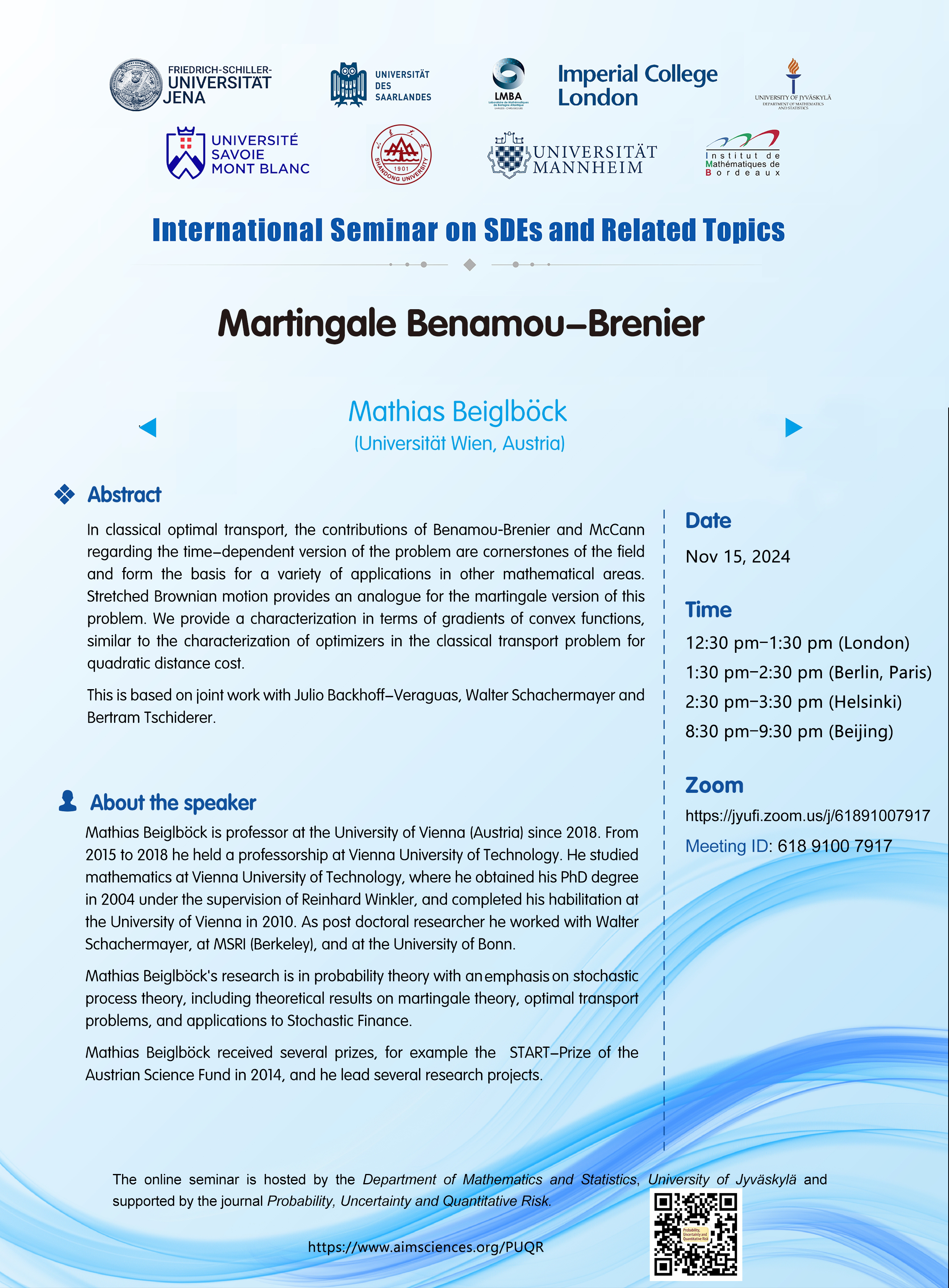 Slides
(Universität Wien, Austria)
Abstract: In classical optimal transport, the contributions of Benamou−Brenier and McCann regarding the time-dependent version of the problem
are cornerstones of the field and form the basis for a variety of applications in other mathematical areas.
Stretched Brownian motion provides an analogue for the martingale version of this problem. We provide a characterization in terms of gradients of convex
functions, similar to the characterization of optimizers in the classical transport problem for quadratic distance cost.
This is based on joint work with Julio Backhoff-Veraguas, Walter Schachermayer and Bertram Tschiderer.
Dec 13, 2024
Arnulf Jentzen Poster: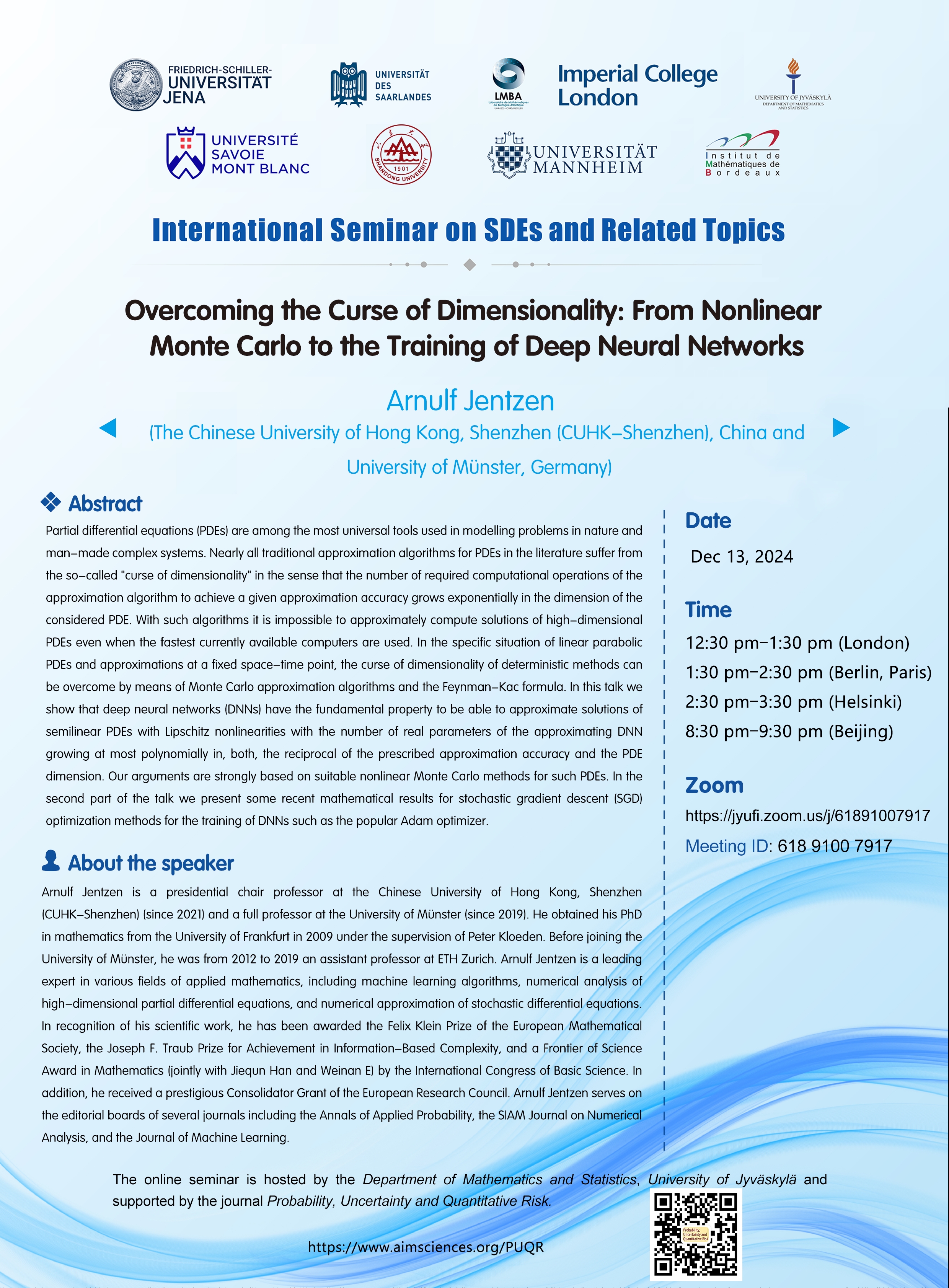 Slides
(The Chinese University of Hong Kong, Shenzhen (CUHK-Shenzhen), China and University of Münster, Germany)
Abstract: Partial differential equations (PDEs) are among the most universal tools used in modelling
problems in nature and man-made complex systems.
Nearly all traditional approximation algorithms for
PDEs in the literature suffer from the so-called "curse of dimensionality" in the sense that the number of required
computational operations of the approximation algorithm to achieve a given approximation accuracy grows
exponentially in the dimension of the considered PDE. With such algorithms it is impossible to approximately compute
solutions of high-dimensional PDEs even when the fastest currently available computers are used.
In the specific situation of
linear parabolic PDEs and approximations at a fixed space-time point, the curse of dimensionality of deterministic methods can be
overcome by means of Monte Carlo approximation algorithms and the Feynman-Kac formula.
In this talk we show that deep neural
networks (DNNs) have the fundamental property to be able to approximate solutions of semilinear PDEs with Lipschitz nonlinearities
with the number of real parameters of the approximating DNN growing at most polynomially in, both, the reciprocal of the prescribed
approximation accuracy and the PDE dimension. Our arguments are strongly based on suitable nonlinear Monte Carlo methods for such PDEs.
In the second part of the talk we present some recent mathematical results for stochastic gradient descent (SGD) optimization methods for the
training of DNNs such as the popular Adam optimizer.
Schedule 2025 Spring
Jan 17, 2025
Jean-François Chassagneux Poster: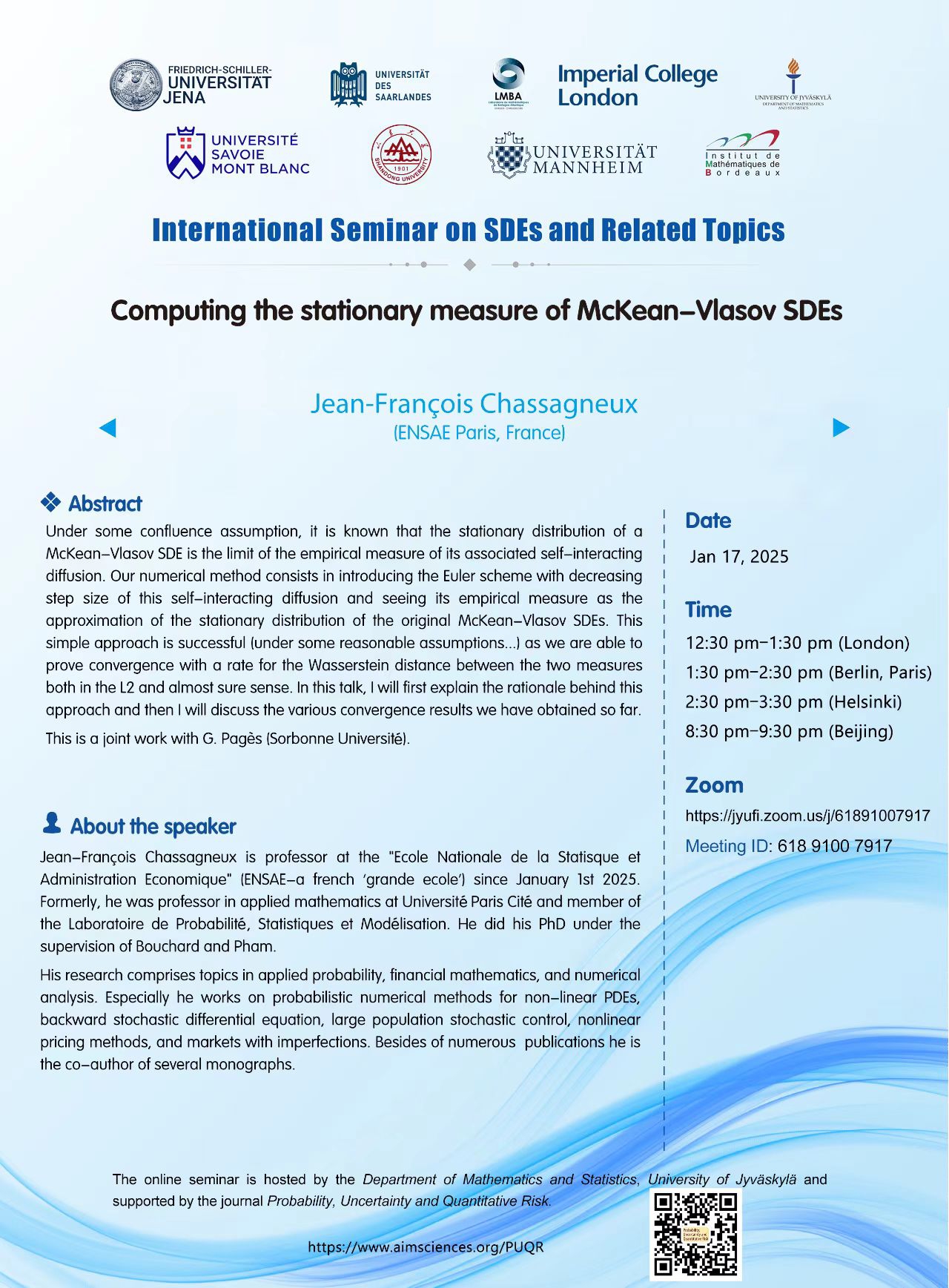 Slides
(ENSAE Paris, France)
Abstract: Under some confluence assumption, it is known that the stationary distribution of a McKean-Vlasov SDE is the limit of the empirical measure of
its associated self-interacting diffusion.
Our numerical method consists in introducing the Euler scheme with decreasing step size of this self-interacting diffusion and seeing its empirical measure
as the approximation of the stationary distribution of the original McKean-Vlasov SDEs.
This simple approach is successful (under some reasonable assumptions...) as we are able to prove convergence with a rate for the Wasserstein
distance between the two measures both in the L2 and almost sure sense.
In this talk, I will first explain the rationale behind this approach and then I will discuss the various convergence results we have obtained so far.
This is a joint work with G. Pagès (Sorbonne Université).
Feb 21, 2025
Gianmario Tessitore Poster: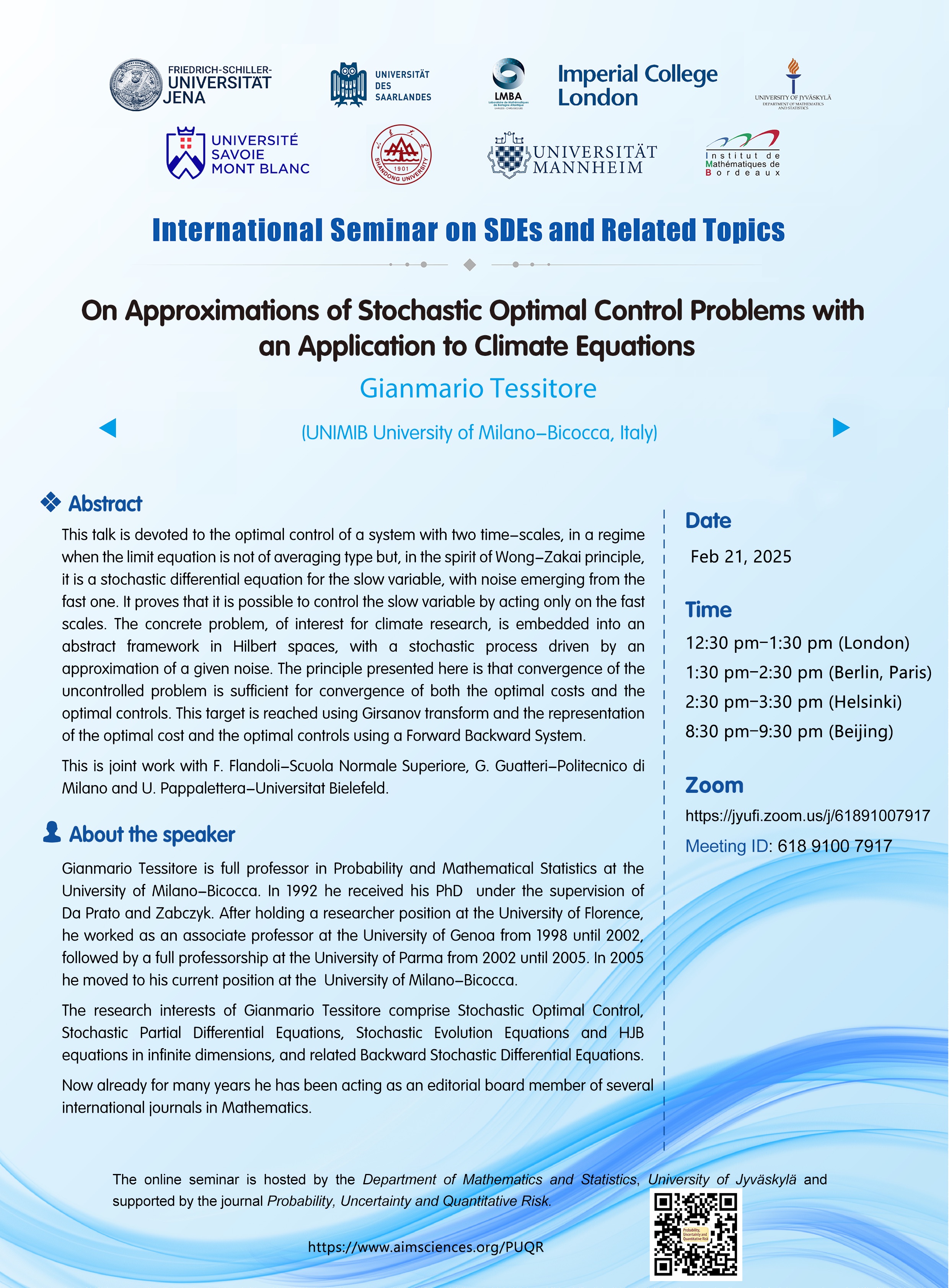 Slides
(UNIMIB University of Milano-Bicocca, Italy)
Abstract: This talk is devoted to the optimal control of a system with two time-scales, in a regime when the limit equation is not of averaging
type but, in the spirit of Wong-Zakai principle, it is a stochastic differential equation for the slow variable, with noise emerging from the fast one.
It proves that it is possible to control the slow variable by acting only on the fast scales. The concrete problem, of interest for climate research,
is embedded into an abstract framework in Hilbert spaces, with a stochastic process driven by an approximation of a given noise. The principle
presented here is that convergence of the uncontrolled problem is sufficient for convergence of both the optimal costs and the optimal controls.
This target is reached using Girsanov transform and the representation of the optimal cost and the optimal controls using a Forward Backward System.
This is joint work with F. Flandoli (Scuola Normale Superiore), G. Guatteri (Politecnico di Milano) and U. Pappalettera (Universität Bielefeld).
Mar 14, 2025
Laurent Denis Poster: Slides
(Université du Maine, France)
Abstract: We study the limit behavior of the solution of a backward stochastic differential equation when the terminal condition is singular, that is
it can be equal to infinity with a positive probability. In the Markovian setting and in the case where the equation is driven by a Brownian motion, Malliavin's calculus
enables us to prove continuity if a balance condition between the growth w.r.t. y and the growth w.r.t. z of the generator is satisfied. We apply our
result to liquidity problem in finance and to the solution of some semi-linear partial differential equation ; the imposed assumption is also new in the literature on PDE.
Finally, we prove that if there are jumps (i.e. the operator of the PDE is non local), we observe a propagation of the singularity, contrary to the continuous case (local operator).
This talk is based on several joint works with D. Cacitti-Holland and A. Popier.
References:
Cacitti-Holland D., Denis L., Popier A. Continuity problem for BSDE and IPDE with
singular terminal condition, Journal of Mathematical Analysis and Applications, Vol. 543, issue 1 (2025).
Cacitti-Holland D., Denis L., Popier A. Growth condition on the generator of BSDE with singular terminal value ensuring continuity up to terminal time,
to appear in Stochastic Processes and their Applications (2025).
Apr 11, 2025 11:30 UTC (daylight saving time)
Arnaud Debussche Poster: Slides
(ENS Rennes, France)
Abstract: Stochastic fluid models with transport noise are popular, the transport noise models unresolved small scales. The main assumption in these models is a very strong separation of scales allowing this representation of small scales by white - i.e. fully decorrelated - noise. It is therefore natural to investigate whether these models are limits of models with correlated noises. Also, an advantage of correlated noises is that they allow classical calculus. In particular, it allows to revisit the derivation of stochastic models from variational principles and allows to derive an equation for the evolution of the noise components. The advantage of having such an equation is that in most works, the noise components are considered as given and stationary with respect to time which is non realistic. Coupling stochastic fluid models with these gives more realistic systems.
May 09, 2025
Emmanuel Gobet Poster: Slides
(CMAP-Ecole Polytechnique, France)
Abstract: We study the numerical approximation of a class of ergodic Backward Stochastic Differential Equations. In order to build our numerical scheme, we put forward a new representation of the PDE solution by using a classical probabilistic representation of the gradient. Then, based on this representation, we propose a fully implementable numerical scheme using a Picard iteration procedure, a grid space discretization and a Monte-Carlo approximation. Up to a limiting technical condition that guarantees the contraction of the Picard procedure, we obtain an upper bound for the numerical error. We also provide some numerical experiments that show the efficiency of this approach for small dimensions.
Jun 06, 2025
Rainer Buckdahn Poster: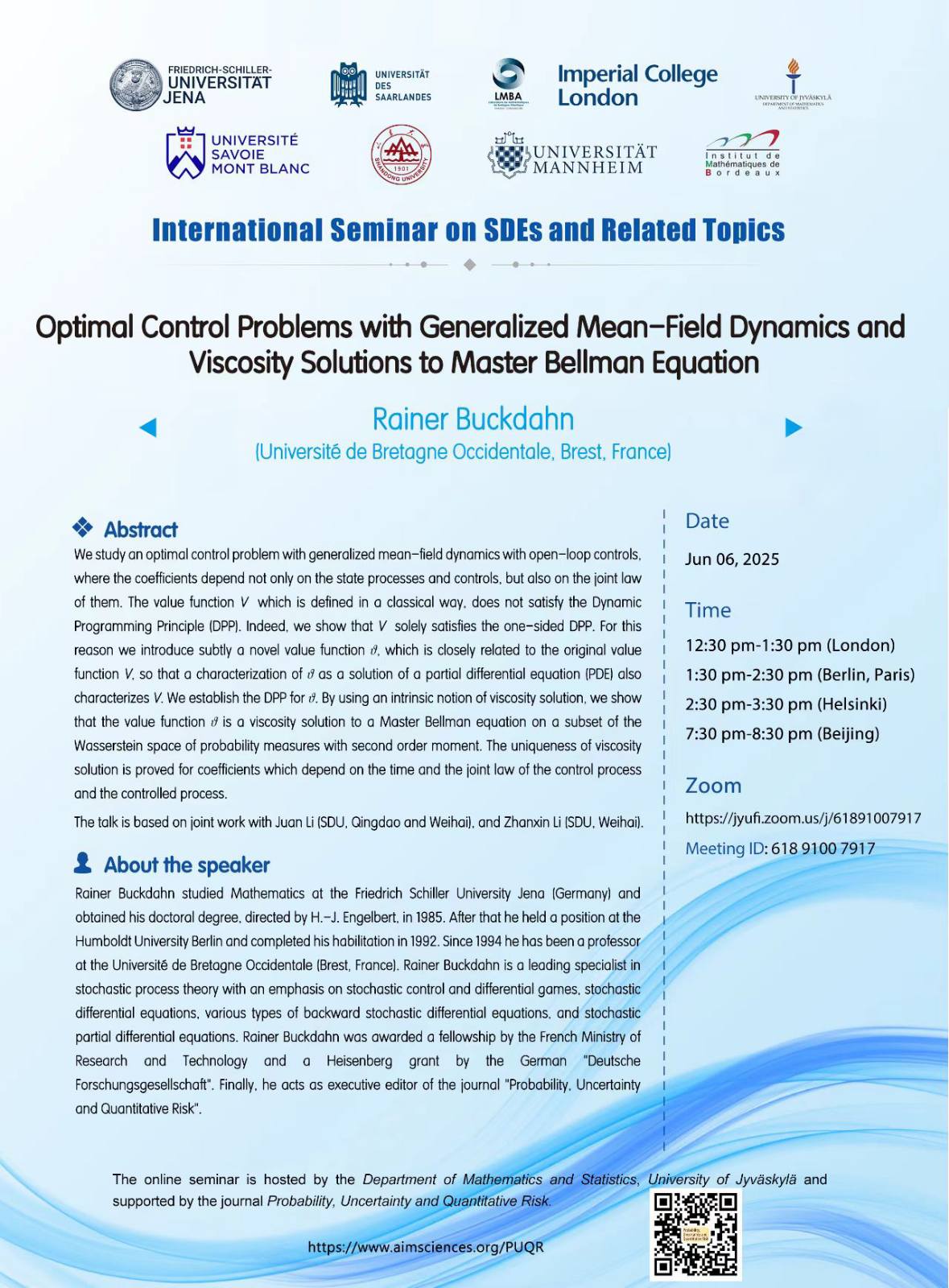 Slides
(Université de Bretagne Occidentale, Brest, France,
Shandong University Qingdao, China)
Abstract: We study an optimal control problem with generalized mean-field dynamics with open-loop controls, where the coefficients depend not only
on the state processes and controls, but also on the joint law of them. The value function V which is defined in a classical way, does not satisfy the Dynamic
Programming Principle (DPP for short). Indeed, we show that V solely satisfies the one-sided DPP.
For this reason we introduce subtly a novel value function ϑ, which is closely related to the original value function V,
so that a characterisation of ϑ as a solution of a partial differential equation (PDE) also characterises V. We establish the DPP for ϑ.
By using an intrinsic notion of viscosity solution, initially introduced in Burzoni, Ignazio, Reppen and Soner and specifically tailored to our framework, we
show that the value function ϑ is a viscosity solution to a Master Bellman equation on a subset of the Wasserstein space of probability measures
with second order moment. The uniqueness of the viscosity solution is proved for coefficients which depend on the time and the joint law of the control process
and the controlled process.
The talk is based on joint work with Juan Li (SDU, Qingdao and Weihai) and Zhanxin Li (SDU, Weihai).