Proximity SQUID
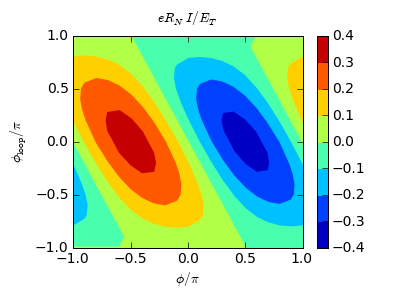
Supercurrent in the proximity SQUID.
Assume the geometry:
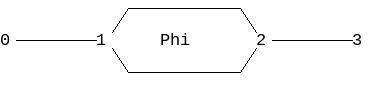
where terminals 0 and 3 are taken as superconducting. What is the
supercurrent between 0 and 3 as a function of the phase difference and
the flux  ?
?
See also
Geometry specification
Define a function that returns the geometry for given phase difference
and phase jump ( ) corresponding to the flux:
def get_geometry(phi, phi_loop):

    # 4 nodes and 4 wires
    g = u.Geometry(4, 4)

    g.t_type = [u.NODE_CLEAN_S_TERMINAL,
                u.NODE_CLEAN_NODE,
                u.NODE_CLEAN_NODE,
                u.NODE_CLEAN_S_TERMINAL]

    # Energy gaps at nodes (has no effect except at terminals)
    g.t_delta = [ 50, 0, 0, 50]
    # Superconducting phases at nodes (has no effect except at terminals)
    g.t_phase = array([ -.5, 0, 0, .5 ]) * phi
    # Inelastic scattering parameter \Gamma
    g.t_inelastic = 1e-9
    # Spin-flip scattering parameter \Gamma_sf
    g.t_spinflip = 0
    # Temperature
    g.t_t = 10
    # Potentials
    g.t_mu = 0


    # Normal-metal structure
    g.w_type = u.WIRE_TYPE_N
    # Wire lengths
    g.w_length = [ 1./3, 1./3, 1./3, 1./3 ]
    # Wire conductance-area products
    g.w_conductance = [ 1, 1, 1, 1 ]
The magnetic field is taken into account with a gauge transformation

which causes discontinuities in the gauge-transformed
 . The function
  can be chosen separately
for each wire, according the vector potential parallel to each, provided
the node conditions are transformed accordingly.
can be chosen separately
for each wire, according the vector potential parallel to each, provided
the node conditions are transformed accordingly.
In this code, the magnetic phase jumps in each wire are specified by
setting w_phase_jump:
# Phase jumps at ends of wires 1 and 2, due to applied field
g.w_phase_jump[1] = phi_loop
g.w_phase_jump[2] = 0

# Specify the connections between wires and nodes
g.w_ends[0,:] = [ 1, 0 ]
g.w_ends[1,:] = [ 1, 2 ]
g.w_ends[2,:] = [ 1, 2 ]
g.w_ends[3,:] = [ 3, 2 ]

return g
Now comes a subtle point: suppose we had chosen
g.w_phase_jump[1] =  phi_loop/2
g.w_phase_jump[2] = -phi_loop/2
to describe the same physical situation. Then,
 ,
even though both
,
even though both  and
and  are gauge-invariant quantities.
The reason why this occurs is simply that the phase difference
 is not gauge invariant, and in the gauge we chose
implicitly when specifying the phase jumps the actual phase difference
is a function of . Indeed, we can easily see that two
gauge-invariant phase differences between the superconductors can be
defined:
is not gauge invariant, and in the gauge we chose
implicitly when specifying the phase jumps the actual phase difference
is a function of . Indeed, we can easily see that two
gauge-invariant phase differences between the superconductors can be
defined:  and
and
 , corresponding to paths going
throught the left and right arms of the loop. Both
, corresponding to paths going
throught the left and right arms of the loop. Both
 and
and
 are
are  -periodic in
their arguments.
-periodic in
their arguments.
In the simpler gauge choice we use below, the in the
numerics is gauge invariant as-is.
Supercurrent
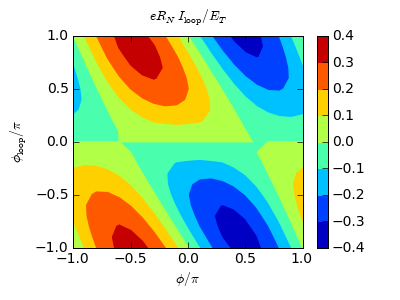
Supercurrent and the circulating current can then be solved as before:
def main():
    output = open('proximity-squid.dat', 'w')

    print >> output, "%% %14s %14s %14s %14s %14s" % (
        "phi", "phi_loop", "T", "current", "circulating")

    for phi in linspace(-pi, pi, 21):
        for phi_loop in linspace(-pi, pi, 21):
            geometry = get_geometry(phi, phi_loop)
            currents = u.CurrentSolver(geometry, ne=260,
                                       output_function=lambda x: None)
            currents.set_solvers(sp_solver=u.SP_SOLVER_TWPBVP)
            currents.solve_spectral()

            print phi, phi_loop, "..."

            for T in linspace(1e-6, 20, 100):
                geometry.t_t = T
                Ic, Ie = currents.get_currents(ix=0)

                print >> output, "  %14.5g %14.5g %14.5g %14.5g %14.5g" % (
                    phi, phi_loop, T, Ic[0], Ic[1] - Ic[2])

if __name__ == "__main__":
    main()
After about 40 min, a result is obtained: at  ,
,
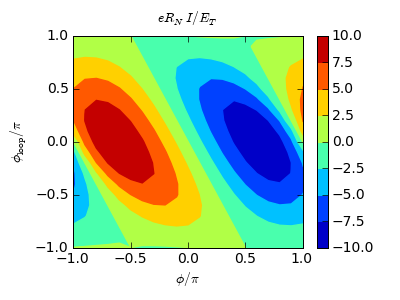
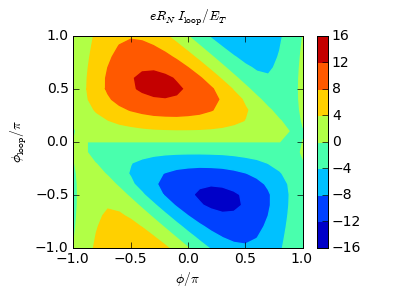
And at  :
: