
It is now commonly agreed upon that the "father of hypertext" was the Director of the Office of Scientific Research and Development, Dr. Vannevar Bush, who published his highly prophetic article "As We May Think" in Atlantic Monthly, July 1945. The article contains a wide range of speculation about future technological advances, and only a couple of pages are directly connected to the issue of hypertext (a word not yet existing then). As the article was written just before the time of electronic computers (in the modern meaning) and the machine Bush imagines, Memex, is mainly mechanical in function, the innovation soon seemed hopelessly outdated. The idea behind Memex, however, was a sound enough description of hypertext as it was later developed. To give credit to Bush, it should be noted that he makes this assertion himself already in the article: future technology may very well develop to directions impossible to predict, and thus the realization of Memex may be quite different from his sketches, but what is important is just the idea.
The motivation for Bush in his article was to find a new project, a new direction, wide and important enough, to direct the huge potential of scientific research left unused after the great war time effort had ended - because of this his rhetorics especially in the beginning, is full of pathos, but after the necessary preparations he gets to his main point: the body of knowledge, scientific and otherwise, is growing so fast that something has to be done if it is to be useful at all. He first acknowledges the potential growth of information, and the need to find a proper mass storage means for it. Microfilm seems to please him well, and additionally he already foresaw the possibilities of magnetic data storage, so actually the storage question was not so acute for him. What Bush saw perfectly clearly was that the main problem lies in finding and using just the information necessary at any given moment. In 1945 Bush already took up the topic that has become widely acknowledged only after Internet was popularized:"Mere compression, of course, is not enough; one needs not only to make and store a record but also be able to consult it."
Indexing had been in use in book format and libraries for centuries, and Bush also saw indexing as necessary but not satisfying alone. His addition to information retrieval was the introduction of recordable traces, paths, or links to the database. The user of Memex would have been allowed to make connections between different kinds and types of data and name those connections; a bunch of similarly titled connections formed paths. He also would have been able to add his own notes to the database and those own additions could naturally have been added to existing paths. Thus, returning to the database, the user could follow his previous associative path through the materials. If we assume that the reason for the data gathering in the first place was to do research in a certain field which was then to produce an article, the Memex database contained the devices with which the author himself (or some other person, for that matter, as the Memex databases were to be transferrable) could return to the structure of the associative think-work which produced the article. Bush uses a lawyer as his example: "The layer has at his touch the associated opinions and decisions of his whole experience, and of the experience of friends and authorities."
The possibility to link together different documents, to gather links to named paths, to add new documents to the database/ paths, and finally, to return to the database and follow the previous paths, are the key issues in any hypertext environment today. What is common to present practice is also the strong role of book form as a model for hypertexts. "It is exactly as though the physical items had been gathered together from widely separated sources and bound together to form a new book." This use of book metaphor has stuck to hypertext practice and theory to the present day, as witnessed in the highly confusing use of "page" in the World Wide Web terminology.
Theodore "Ted" Nelson was the man who coined such terms as hypertext and hypermedia. In his book Literary Machines (first published in 1981, several revised editions since that) Nelson gives a thorough description of his grand idea, "A program intended to make possible a new unified electronic literature […] a computer program intended to tie everything together and make it all available to everyone", known as the Xanadu[1].
Nelson makes clear his indebtedness to Vannevar Bush: "I say Bush was right, and so this book describes a new electronic form of the memex, and offers it to the world."[2]Xanadu was a plan for an electronic form of Memex - database with user defined links, paths and notes - but it was also something much more. While Memex in principle was a local machine (although the records might have been transferrable), Xanadu was a global system (”a unified concept of interconnected ideas and data”). While it is now possible to argue that ”Xanadu never shipped”, Nelson's ideals were still concretized in all their global, unifying aspects, in World Wide Web[3].
Nelson defines hypertext as ”non-sequential writing”[4]:
"Well, by "hypertext" I mean non-sequential writing -- text that branches and allows choices to the reader, best read at an interactive screen. As popularly conceived, this is a series of text chunks connected by links which offer the reader different pathways.”
He also states that ”Hypertext can include sequential text, and is thus the most general form of writing” and adds in a footnote, ”In one direction of generalization, it is also the most general form of language.”[5] The improvement of writing in hypertext means that authors can write more freely, more flexibly, hypertext writing bending better to accomodate the forms of the topic in question. Also the readers may more freely follow their interests when reading hypertext.
Nelson’s grand idea was to build a global network, where individual hypertext documents could be linked to each other when necessary – in his own words, to make ”instantaneous electronic literature” possible. His definition for ”literature” was a very general one, literature for him meaning "the information that we package and safe". Networked computers were seen as platform for the most general form of writing – hypertext – thus, he termed computers as ”literary machines”. There is also the stress on the essential referentiality of literature which comes very close to the poststructuralist text concepts of Jacques Derrida and, especially, Roland Barthes:
In this ideal text, the networks are many and interact, without any one of them being able to surpass the rest; this text is a galaxy of signifiers, not a structure of signifieds; it has no beginning; it is reversible; we gain access to it by several entrances, none of which can be authoritatively declared to be the main one; the codes it mobilizes extend as far as they can reach, they are indeterminable (meaning here is never subject to a principle of determination, unless by throwing dice); the systems of meaning can take over this absolutely plural text, but their number is never closed, based as it is on the infinity of language.[6]
What to Barthes was simply ”text” is for Nelson the docuverse. Docuverse is the grand total of all documents in the global network, ”a single great universal text and data grid”[7]. Xanadu the vision (as described by Nelson) in many ways seems to be superior to the World Wide Web we know, but it clearly has its drawbacks too. Despite all his ingenuity, there are still some blind spots in Nelson’s vision.
One of the clearest advantages of Xanadu would have been an in-built royalty system based on electronic money. The royalty system was developed to avoid copyright problems. Using a document by another author, one simply had to pay a certain amount of e-money, and that would be it:”…automatic royalty on every fragment (and thus freedom to quote between documents)"[8]. The specialty in electronic money was its division to very small units – something like 1/1000 of cent or so[9]. The price of using a single document (or a part of it) must be kept at a very low level. One of the curious things is that in Xanadu there would be no free documents – the price may be low, but there is always a price. Thus, the old classics, today seen as common property and free for use (as so well illustrated in Project Gutenberg archives), would be controlled by a new faculty: ”Ancient documents, no longer having a current owner, are considered to be owned by the system – or preferably by some high-minded literary body that oversees their royalties.”[10]
The ”high-minded literary body” is one of the striking contradictions in Nelson’s system. In what should be a totally free and unrestricted forum for publicizing and using all kinds of documents, there is also an element of enlightened control based on an almost utopian belief in altruistic power. All in all, Nelson is clearly following in Bush’s footsteps what comes to the enlightening role of the docuverse:
"electronic publishing will mean lower-capital entry (and thus smaller publishers), constant revisability of all documents with linked version update, and finally open hypertext publishing -- the growing-together of a great jungle of interconnections among symbiotic documents, under separate ownership, becoming inseparable from the greater whole. […] the most sophisticated readership and usership civilization has yet seen."[11]
”The system… may or may not work. But some system of this type will, and can bring a new Golden Age to the human mind. Imagine a new libertarian literature with alternative explanations so anyone can choose the pathway or approach that best suits him or her; …; imagine a rebirth of literacy."
Comparing this to the sex and advertisements driven contents of Internet gives us quite a lot to think about. On the positive note we may still hope that at least some of the fine ideals of Bush and Nelson one day may realize. The more pessimistic may think, however, that Nelsonian utopia is just that, utopia with no chances in the real world.
The main principles of publishing will not change much from the old ways. The document, the author, the writing, all will still be essential factors even though the document and the writing be slightly modified. The author as authenticator of the document, as well as the integrity of the document, are as essential properties as ever; this Nelson makes clear. He goes as far in stressing the continuity rather than discontinuity with the old forms as stating:”we consider that this system may best be considered as the printing press of the future”. Insofar as this comparison, or use of old terms, restricts the docuverse mainly to previous models of print, this statement seems odd, and even misguided. There are such real-time participatory writing forms (like MUDs) in WWW which cannot be justifiably grounded in the printing press. On the other hand, as far as the category of publishing as such is concerned, we can quite well say that the Xanadu ideals are actualized in WWW:
thus a carefully designed system of publication, including conventions for copyright and royalty – surprisingly like that of paper publishing – has been worked out.[12]
The facts governing, for example, academic journal publishing are not much different in electronic format than in print. This was well presented in the debate Stuart Moulthrop and Joel Felix had in 1998 concerning the ways e-journals could and should finance their work[13]. But then, restricting the discussion to this traditional notion of publishing, it is hard to see what is so surprising in that it resembles paper publishing. What comes to maintaining formal and academic standards, Nelson nicely expresses the main point:” It [publication] could be merely by a ”publish” button on the user’s console – but the dangers of rash publication to an individual’s reputation, legal liabilities and career could be great. Some formalized techniques are therefore required for ”committing to publish” …”[14]
The greatest novelty in the brave new literature for Nelson is its ”instantaneous” accessibility, which, without a doubt is something remarkable in the WWW today. In addition to simple linking of materials Nelson advocates ”transclusion”, a way to embed parts of documents to new contexts. Transclusion takes even stronger use of instantaneous accessibility than linking, since it helps to (re)present both the primary document and the cited document simultaneously[15]:
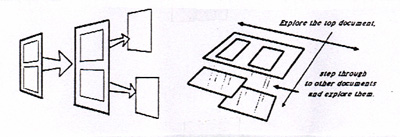
There certainly is something tempting about the idea of transclusion, but it is not always possible to find a certain passage from a text, which could then be used as an embedded citation – in cases like these it is much more pragmatic just to a have a link to the whole document. Transclusion, then, should be seen as a complementary device to other linking devices, like two-way links which also are a feature of Xanadu. Nelson himself is totally convinced of the huge importance of transclusion, though:
"[transclusion] means that part of a document may be in several places -- in other documents beside the original -- without actually being copied there. […] [E]lectronic publishing without transclusion is retrograde. […] transclusion as the central means for organizing our work, clarifying the work of others, and cleaning up copyright.”[16]
One of the great advantages in hypertext writing would be its ability to represent ”the true” structure of information. In addition, when the information is complex enough, the hypertext would be the only possible way to represent it. Once again, there seems to be some kind of inherent contradiction: while it seems plausible to assume that hypertext is, in a sense, ”natural” way to represent complex information, the almost metaphysical notion of ”true structure” seems incompatible with the stress on non-sequentiality and reader choice:
There are two outstanding arguments for breaking away from sequential presentation. One is that it spoils the unity and structure of interconnection. The other is that it forces a single sequence for all readers which may be appropriate for none.
Nelson's definition of hypertext has been largely accepted as a basis for later theoretical developments, but especially the notion of non-sequentiality has proved to be problematic. Mostly, this has been first reformulated as 'non-linear', and then rejected by various means. The preferred way to describe hypertext has been, like George P. Landow does, 'multilinear'[17]. There is a notable exception to this usage. Espen Aarseth (1997) has taken up the question in detail, and according to him, there has been a misconception behind this conceptual reformulation. While Nelson, according to Aarseth, was writing about hypertext as a structure (which is a network and, topologically speaking, clearly and simply non-linear), the later theorists have been writing about the readings of hypertexts (which as temporal experiences are unavoidably linear). Thus, hypertext as a structure is non-linear, but there may be an infinite number of multiple linear readings of it.[18]
As minor as this clarification seems, it has an important implication: that of totally confusing the discussion about narrative hypertexts, or, hypertexts as narratives. For Aarseth, it is a grave mistake to try and analyze hypertexts as narratives. He sees them as belonging to a totally different category than narrative texts, this new category being named by him as 'ergodic texts'. In ergodic literature "nontrivial effort is required to allow the reader to traverse the text."[19] In the case of hypertext, that nontrivial effort consists of navigating one's way through the networked ('labyrinthine') structure by various means. Narrative may perform as a function in hypertext, and the reader may retrospectively construct his/her reading experience as a narrative, but this should not lead us to mistakenly see the hypertext itself as narrative. Even though in principle I agree with Aarseth, I still think there is a huge grey area where the narrative and ergodic aspects find different kinds of equilibrium states.
Nelson predicted that the introduction of hypertext would give birth to numerous new kinds of writing:
…this simple facility – the jump-link capability – leads immediately to all sorts of new text forms: for scholarship, for teaching, for fiction, for hyper-poetry.[20]
We can see today that this has been the case indeed – especially in WWW we can find a wealth of experiments in new writing. While hypertext as a general form behind WWW at large, and in a more specific way in hyperfiction, has been a major influence behind the development, there are such functions at work there that clearly do not belong to the area of hypertext. For these emerging forms (and their predecessors in print media) Aarseth has coined the term cybertext. While early theorists of hypertext literature – George P. Landow and Jay David Bolter most notably – were strongly attached to the Nelsonian definition of hypertext, as employed in the Story Space software and in hyperfiction written using it (eg. Michael Joyce’s Afternoon etc.), Aarseth’s theory of cybertexts and ergodic literature is the first systematical approach to the broader field of (mainly) digital textuality and literature.
The first Hypertext conference was in 1987. Around the annual conference a hypertext community was formed. Along with the technically oriented scholars and interested persons, there was also a fair amount of "literary" persons present. This strong relation to technical interests heavily influenced the early hypertext literature theorizing. George P. Landow wrote about the ”rhetorics of hypertext” and stressed the importance of giving enough information concerning links (departure & arrival information etc.). While Landow wrote extensively about the close relationship between hypertext writing and deconstructionist ideas – especially how the reader becomes an author – his point of view was clearly to teach people write good hypertext documents. Landow’s role in introducing hypertext to literary-humanist audience cannot be overestimated, but the occasionally simplifying (and even misleading) comparison between hypertext and deconstruction is kind of a burden to hyperliterature theory even today[21].
As long as the phrase ”the reader as author” is understood in terms of Roland Barthes’ writerly text, there are no problems (but then, there is nothing new in hypertext either)[22]. If this is taken in more concrete sense, then we have to deal with more complex phenomena than simple hypertexts – this topic will be discussed in more detail below.
Another big problem lies in dealing with links in terms of intertextuality. While links certainly offer an easy way to explicate some intertextual connections, this superficial similarity should not blind us to the obvious fact that these two mechanics differ fundamentally from each other. Only the special cases of intertextuality, citation and direct reference, are somehow compatible with hyperlink. To be exact, hyperlinks are a means for reference, while Nelson’s transclusion would do the citation. When we go to more general forms of intertextuality, to intertextuality of Barthes and Julia Kristeva, it should be clear that no amount of links could ever map all of the palimpsest history of texts working in every text fragment. One has to careful here:it is, finally, not a question of number, that there are too many intertextual connections to map with links – rather, intertextuality is a part of interpretation and because of that, never to be fixed in a set of links.
On the other hand, there are lots of things one can do with links, but not with intertextual references. I’ll give a list of eight such features[23]:
1. In a static print text the reference cannot be changed at will, while the destination of a link is always changeable. (It should be noted, however, that the historical-contextual development may cause unintentional changes to intertextual references.)
2. The links cannot be ”open” – it has to be fixed somewhere (even though that somewhere may be changed later).
3. References cannot be timed, so that they would be available only at certain times, or, during a certain interval.
4. Reference cannot directly use other media as a link can (connecting to an audio file, for example, or to a real time video feed etc.)
5. References cannot be directed to posterior processes (not intentionally, at least), or, track processes in real time.
6. References cannot be chained as links can. (Once again, this is more a difference in authorial control - intertextual references do (potentially) generate endlessly new references, but these cannot be predetermined in a fixed order as is possible with links.)
7. Intertextuality cannot be left as an empty structure to be filled in by the reader like links can.
8. Links can be two-way, unlike references. (The sets of intertextual references attached to certain signifiers may, however, overlap in a way which has an effect very similar to two-way links.)
Jay David Bolter discusses the spatiality of hypertext writing in his Writing Space (1991). Ever since then it has been a commonplace to think about hypertext as ”spatial writing”. It is true that there is a strong spatial element in many hypertexts – the screen space is used as one of the signifying structures:
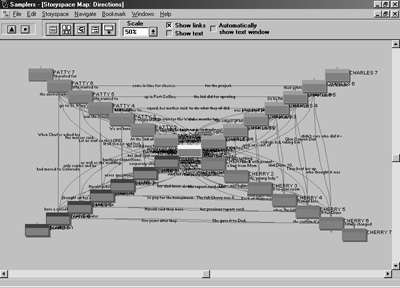
A Screen From Samplers: Nine Vicious Little Hypertexts by Deena Larsen
At the same time, however, there is a strong opposite tendency, tendency towards non-spatiality caused by the hyperlinks. We are easily mislead by our metaphors of "going to places", or links "taking us to places", as well as hypertext interfaces and mappings focussing on the spatial arrangement of lexias. There is not any difference, however, between two lexias represented in a map side by side, or two lexias in a map in opposite corners of the screen; a link always causes two lexias to be joined, despite their relative places in any maps. If we would think of links as cuts in film, instead of as vectors between two boxes, the spatiality wouldn’t be so obvious a frame for our thoughts. If there is a hypertextual space, it is a curious space indeed, not anything like the Newtonian space the hypertext maps would make us think of – there is no such thing as distance between any two lexias joined by a link; there is no sense in claiming that one link is "longer" or "shorter" than some other link. The only way to think about distance is in terms of the number of links necessary to get from one lexia to another. So, there is a conceptual space in which a hypertext is situated, but exploring the nature of that space has barely begun.
The hyperfiction authors Michael Joyce, Stuart Moulthrop, and Deena Larsen have all been active participants in hypertext community. Joyce played a big part in designing the Story Space hypertext authoring software, he wrote the classical ”hypernovel” Afternoon (as well as several other hypertexts), and has also been an important theoretical thinker. His division between explorative and constructive hypertexts has been widely used:
By exploratory use, I mean to describe the […] use of hypertext as a delivery or presentational technology,[…] Exploratory hypertexts encourage and enable an audience (users and readers are inadequate terms here) to control the transformation of a body of information to meet its needs and interests.[24]
By constructive use, I mean to describe a […] use of hypertext as an invention or analytic tool,[…] Just as exploratory hypertexts are designed for audiences, constructive hypertexts are designed for what Jane Yellowlees Douglas (1987) has, following Barthes, termed ”scriptor[s].” […] More than with exploratory hypertexts, constructive hypertexts require a capability to act […][25]
Also his ideas about the texture of words and the contours of hypertext as well as of interstitial fiction, while there is a range of opinions concerning their real meaning, have been recognised as important. In his writings, however, Joyce has clearly been a creative writing teacher looking for ways to employ hypertext as a teaching tool[26]. Stuart Moulthrop – the author of Victory Garden, Hegirascope, Reagan Library etc. – has been discussing the broader changes in literacy and fiction in his numerous essays and talks. While he has used a variety of technical ”gimmicks” in his own fictional writings, the stress in his papers has been mainly on the implications that hypertext and Internet have to our cultural landscape[27].
One of the most important figures in the crossroads of techical features and literary appropriations of hypertexts, has been Jim Rosenberg, who, in his turn, is not a fiction writer, but a programmer and a poet (in this order, as he says himself). A very dense summarization of the most important topics in his thinking has been published in the short article ”Interactive Diagram Sentence: Hypertext as a Medium of Thought” (1996). There he looks for the ways to take hypertext to the lowest levels of language, ”slightly above the word level”. This way hypertext could be used to produce originally (or, natively) hypertextual thoughts, not just to connect thoughts in themselves not in any way hypertextual. His ponderings about ”spatial prosody”, as well as about the ”structure of hypertext activity” (which lowest level - for example, following a link - he calls acteme) and about programmability are highly important for our understanding of hypertext and hypertextual writing[28]. Rosenberg has also frequently asked for alternative hypertext authoring tools, ones that are not limited to the dominant node-link –mode. As if echoing Nelson, he has written about the need of conjunctive hypertexts, where several links could be chosen simultaneously, instead of the either/or disjunctive hypertexts we have:
Typical hypertext structures are or-based, i.e. disjunctive: from lexia L with links X, Y, and Z one may choose X or Y or Z. Syntax structures are and-based, i.e. conjunctive: a sentence with parts X and Y and Z consists of X and Y and Z8. […] This is not to argue against the use of disjunctive structure, or "classical" hypertext links. Rather, the need is for both to be available as an author requires. [29]
Cybertextuality, as Aarseth defines it, is such a perspective on all texts which pays close attention to the ways they work. Texts in cybertextual scrutiny are understood as machines, not in a metaphorical, but in a very concrete sense. Cybertextuality is by no means limited to digital texts only – also print texts have their kinds of functioning. Through a convincing statistical analysis Aarseth shows how the oft-used division between print and digital literature is misguided – ”make your own adventure” type of print books (based on several storylines read according to luck in rolling dices) are in many ways much closer to Afternoon-style hyperfiction than other print literature. Thus, in principle, cybertextuality as such does not acknowledge any fundamental difference between print and digital literature. On the other hand, in practice, the digital form enables much more flexible ways to design textual functioning, which inevitably means that the focus, after all, is clearly on digital texts.
Another important thing to note about the concept of cybertextuality is that it is not only about ”literature”, not even in the broadest sense of the word. Cybertextuality includes forms like computer games which should not be violently made to fit into the category of literature, if we want to understand them fully. Computer games, MUDs etc. are cybertexts, but not literature. When dealing with literature, Aarseth introduces another new term, ergodic. Ergodic literature requires ”non-trivial effort” to traverse a text[30]. Following the lines by eye-movement and turning the pages are classified as ”trivial” efforts, anything additional as ”non-trivial”. Thus, books like Raymond Federman’s Double or Nothing (1972), in which text is occassionally printed to circle around the page and thus force the reader to turn the whole book a full 360 degrees in her hands, can be seen as an example of ergodic literature. Vladimir Nabokov’s Pale Fire (1962), in which the reader has to jump between the poem ”Pale Fire”, the "Commentary", and the "Index", is a case of ergodic literature etc[31]. Once again, as these examples should clearly show, there is ergodic literature in both the print and the digital format[32].
The functioning of texts may be located either in the production phase (procedurally constructed texts), in texts themselves (programmed texts), and in reading (ergodic literature). These may also occur simultaneously. While hypertext is just a sub-category of cybertexts and even though its functioning is strongly limited (especially if we think of "pure hypertext" in Aarsethian terms) I still want to emphasize that hypertext - pieces of writing inter-linked - is "the most general form of writing" (quoting Nelson) and as such, an essential basis for the multitude of cybertexts.
In describing ergodic literature we need the concepts of textons and scriptons. Textons are the ”building blocks” of a text, the deep structure. Scriptons, in turn, are the possible combinations of textons, the surface level as seen by the reader. With any given hypertext, all the individual lexias (nodes) together are the textons, all the combinations of them, as chosen by any individual reader, are the scriptons. Or, with print texts like Marc Saporta’s Composition No. 1(1962) and B. S. Johnson’s The Unfortunates (1969) where the text is printed on loose pages meant to be shuffled and read in random order, each leaf is a texton, all the orders in which they happen to be read are scriptons.
Taking into account the different ways textons and scriptons may behave, and all the ways in which the reader has to participate in the meaning production of any text, Aarseth has formed a typology for possible text types, comprising seven variables[33]:
1. dynamics: static (scriptons are constant), intratextonic dynamics (the number of textons is fixed, the scriptons may change), textonic dynamics (the number and content of textons may vary)
2. determinability: determinable (the same response to a given situation will always produce the same result), indeterminable (the results of responses are unpredictable)
3. transiency: transient (mere passing of user’s time causes scriptons to appear), intransient (scriptons appear only through user’s activity)
4. perspective: personal (requires the user to play a strategic role as a character in the world described by the text), impersonal (reader not involved as a participant)
5. access: random (all scriptons are readily available to the user at all times), controlled (some scriptons are available only when certain conditions are met)
6. linking: explicit, conditional, none
7. user function: explorative, configurative, interpretative, textonic (see below)
Naturally, this classification isn’t necessarily ”definitive”, there may be other (even better) ways to do this mapping, and certainly there are limit cases and hybrids which do not easily suit these categories[34]. Nonetheless, this is not a purely theoretical-speculative classification but one based on an analysis of a set of real texts – thus, it has a solid empirical backing. What’s most important, though, is the heuristic value of this model. From the seven variables and their possible values we can construct 576 different genre positions, of which only a dozen at maximum has been used so far (a basic model for print literature being: static, determinable, intransient, impersonal perspective, random access, no links, interpretative). Even though we may assume that some of these genre possibilities remain purely theoretical, there is still plenty enough room for experiments with text-only modes of cybertext – that is, there are alternatives to the dominant "change for the multimedia" movement.
User function category in Aarseth’s typology is of special importance. Basically, what it comes down to, is to seriously think about the meanings of the fashionable term ”interactivity”. As should be evident, at least since Roman Ingarden’s writings, all literature is interactive – the literary work of art is not completed without the active participation of the reader. There are many ways in which the reader may participate in the literary meaning construction, and Aarseth has divided these into four basic user functions. The functions and their relations to other related concepts are illustrated in the following diagram[35]:
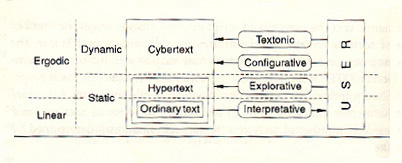
Interpretation is the most basic user function, all texts require interpretation. Explorative function means choosing one’s path through the textual materials available (or, in other terms, constructing scriptons from textons available) – I have proposed elsewhere that we might use ”selection” as an additional function (in strictly limited cases where navigation feels inappropriate). Configurative function means the reforming of the textons or their relations (linking) in the personal document. Textonic function means the possibility to actively participate in the writing of the texts – by writing additional text, changing pre-existing text, or by deleting it; writing, it should be noted, may also include programming. In the popular usage of the term ”interactive” the explorative (or, selecting) function seems to prevail. In the previous discussions of hypertext literature usually the textonic function has been foregrounded – with hypertext literature ”the reader becomes the author” has been a popular phrase; but as the diagram above illustrates, the textonic function (which allows the concrete co-authorship) does not belong at all to the domain of hypertexts! As Aarseth writes, ”confusing the power of a hypertext reader to that of the author, is like confusing the power of a tourist guide to the power of a city architect”[36]
There are some remarks to make about Aarseth’s model. First of them is Aarseth’s definition of hypertext. For him hypertext proper is a static structure – there is variation in scriptons (from one reading to another) but the textons and their relations (the links) are invariable. Thus Aarseth can claim that Afternoon is not really a hypertext because it employs ”conditional links” – links that are active only when certain conditions (depending on the reader’s choices) apply. Keeping in mind the formulations of Bush and Nelson considering hypertexts, this restriction is clearly incompatible. The division static/dynamic seems a bit artificially constructed to foreground the difference between hypertexts and cybertexts.
The second remark concerns the question of narratives. Aarseth makes a strong categorization saying that ergodic texts are not narrative texts – they belong to totally different categories. There are several levels to this assertion. At heart this categorization seems sound – ergodic texts include features which clearly cannot be understood in narrative terms. Furthermore, ergodic texts may include features directly incompatible with notions of narratives. On the other hand, in most ergodic texts too, there are strong narrative elements (which Aarseth never denies). And in many cases the narrative elements may be even stronger than the ergodic elements – thus, there is a grey area of limit cases not simply either/or. In addition, narratives may be seen as interpretational models or frameworks, with which even many clearly ergodic texts are read. It is easy to sympathise with Aarseth in that narratives have been the dominant mode for all representation (or, narrativisation in interpretation in most fields of study) for a long time now, and shifting the focus to things non-narrative might be helpful for a change.
The third remark concerns the temporal aspect. Aarseth makes it clear that the temporal dimension, the possibility to manipulate temporal elements in texts, are greatly expanded in digital form. This is, however, the one undertheorized aspect in his otherwise groundbreaking study. Stressing the temporal aspect more strongly might have resulted in a clearer difference between print and digital texts. While it is true that cybertextuality in itself does not provide a cut between print and digital texts, it possibly should be articulated more strongly that there are things print text can not do, while they are possible, and even easy, to do in digital texts. Markku Eskelinen has mapped these temporal possibilities in his seminar paper ”Omission impossible. The Ergodics of time”[37] quite interestingly.
To sum all this up briefly, we may start by stating that there are two levels of time involved: interface time (the physical span of time that the reader interacts with the text) and cognitive time (the span of chronological time that the reader constructs or reconstructs, imaginatively, to encompass the content of the poem or narrative).[38] Because of the manipulation of temporal aspects made possible by cybertextual techniques, the relation between interface and cognitive time is highly problematic; and in some cases the difference may be totally erased. Another way, then, is to take a closer look at the several ways in which temporal change may take effect.[39] The whole text may be temporally limited, so that it will cease to exist at a certain moment. This effect may be ironically simulated in print literature, like in Eskelinen’s Semtext (1990) where some of the chapters have expiring dates, but what is the real content of that gesture is a matter multifarious ontological pondering. A digital text in WWW can be deleted once and for all, if wanted (there is, however, always the question of pirate copies – if there are additional copies circulating, then the nihilation of digital text is as impossible as with print texts; a programmed self-deleting is not an answer since that kind of programming can always be cracked by the pirates).
The functioning of a cybertext may vary, so that it occupies different genre positions (see the typology above) at different times. A text may be transient at some phases (the lexias following each other automatically) and intransient at others (the reader has to make a selection before the lexias change). The reading/response time for the whole text or parts of it may be unlimited, limited but long enough, or, limited and too short. If the reading time for the whole text is strongly limited, this means that the text cannot be read in full.
The possibility of rereading the whole text or parts of it may be restrained, limited or unlimited. William Gibson’s Agrippa (1992) is probably the best known case of a text which cannot be reread. An interesting limit case here is Stuart Moulthrop’s Reagan Library, in which revisiting a lexia causes it to change – each revisit in a certain lexia increases the amount of text there (”decreases noise”). Thus, reader may revisit a lexia she has read before, but the contents of that lexia change each time. To make the situation more complex, there is a limit to changes, after four revisits the subsequent revisits do not cause any more changes – but even after that, it is impossible to revisit the lexias as they were during the first, second or third reading.
The whole text may include different time zones – some parts following a more frantic rhythm than the others, for example. Even the screen may be divided to frames each obeying a different time scheme. And finally, the temporal change, here as everywhere, may be linear or cyclic.
Through temporality we come back to the question of narratives and of narratology. Even though narratology has developed quite an elaborate machinery to deal with many kinds of temporal manipulations and distortions, it clearly cannot answer to all the morphing in cybertexts caused by the empowered interactivity and temporal machinations. As Aarseth says, they are ergodic, not narrative texts, and because of that, by definition narratology alone is not enough in analysing them. I would still like to make an attempt to compromise. While it is clear we do need new tools to accommodate all the new properties in ergodic literature, it still seems plausible that we may use narratological analysis locally, and in connection with other methods. What we have to do is to resituate narratology into the new framework of literary theory which, generally, looks into texts from the cybertextual point of view.
[1] The name is borrowed from Keats' poem "Kubla Khan" - but Nelson also mentions the connection to the great Xanadu in Welles' Citizen Kane.
[2] Nelson 1993, 1/4. Another important figure was Douglas Engelbart, who is the third link in the chain of hypertext development. Engelbart first took Bush’s ideas to the computer field. Augment was his hypertext project – augment, as an augmentation to human intelligence and reasoning. Today Engelbart is best known for the spin-offs of his work: the mouse and windowing. Nelson openly gives credit to Engelbart:” Engelbart's NLS system was really the first hypertext system, but Xanadu the first to be called so.”
[3] Nelson himself strongly despises WWW - in all its unplanned, messy ad hoc solutions based structure it represents everything that Xanadu was planned not to be. It should be noted that the story of Xanadu has not come to an end yet, Nelson is still actively working with it.
[4] Nelson 1993, 0/2.
[5] ibid., 0/3.
[6] Barthes 1993, 6.
[7] Nelson 1993, 2/53.
[8] ibid. ”Preface to the 1993 edition” (unnumbered)
[9] ibid. 5/11-13; the charge would be per byte, for that reason the unit must be very low; Nelson named this unit as nib.
[10] ibid. 2/29-30. In a recent lecture at Jyväskylä, however, Nelson mentioned that naturally public domain publishing is one option in Xanadu.
[11] ibid. ”Preface to the 1993 edition” (unnumbered)
[12] ibid. 2/41.
[13] Moulthrop defended the practice Postmodern Culture had adopted (PMC joined bigger cluster of academic journals, which charged subscription fees) while Felix advocated Electronic Book Review’s choice of financing the magazine through (banner)advertising and keeping the magazine free for users. See Electronic Book Review 6a (Winter -97/-98), http://www.altx.com/ebr/ebr6/ebr6.htm
[14] Nelson 1993, 2/42-43.
[15] Ibid., 2/34.
[16] Ibid., ”Preface to the 1993 edition” (unnumbered)
[17] Landow 1992, 4.
[18] Aarseth 1997, 2-3.
[19] Ibid., 1.
[20] Nelson 1993, 2/26.
[21] See for example Landow 1992, 8-13.
[22] Of Barthes' readerly and writerly texts, see more Barthes 1993, 4.
[23] I am mainly indebted for this list to Markku Eskelinen – the list (in somewhat different form) first appeared in an article we co-authored (Eskelinen & Koskimaa 1999)
[24] Joyce 1995, 41.
[25] Ibid., 42; Douglas 1987 is an unpublished seminar paper "Beyond Orality and Literacy".
[26] See especially Joyce 1995; 1998; Bernstein & Joyce & Levine 1992.
[27] See, for example, Moulthrop 1995; 1997b; 1999.
[28] See Rosenberg 1996a; 1996b; 1996c; 1998.
[29] Rosenberg 1996a, 114; compare this to Nelson:”It would be very nice if we could send a request to the back end for the AND of links, as in, 'Show me all the material linked to by both an A link and a B link.'" (1993, 4/58).
[30] Aarseth 1997, 1.
[31] Interestingly enough, Ted Nelson tells:”[…] I believe in 1969, I arranged permission from the publishers of Nabokov’s Pale Fire-- a brilliant poetic hypertext—to use it in the demo. But the IBM people rejected this as ”too far out.” Thus progress must wait for the halt and the lame to catch up.” (1993, 1/31).
[32] The digitized texts in the Project Gutenberg archives could be examples of non-ergodic digital texts. These text files are read, even though on the computer screen, in the same manner as any print text. One could always argue that downloading the text file, and opening it in a program suitable to read it, are clearly non-trivial efforts required before the reader can even start traversing the text. As a counter argument we can state that downloding and opening a reading program are external and contingent functions – first: one has to acquire a book before one can start reading it; and two: with the development of electronic reading devices these functions will be simplified and naturalized so that they won’t be that different from choosing a book from a book shelf.
[33] Aarseth 1997, 62-65.
[34] Markku Eskelinen (1998a) has discussed Stuart Moulthrop’s Hegirascope as just this kind of hybrid: in Hegirascope the time is text-based, because the screens follow each other automatically with a thirty second delay. There are, however, hypertext links in almost every page, and if the reader is fast enough, she may click the links before the automatic screen change, and thus, turn the time reader based. Theoretically, a constantly fast enough reader might not even notice the automatic screen change feature.
[35] Aarseth 1997, 64.
[36] Ibid., xx.
[37] Eskelinen 1998a.
[38] Luesebrink 1998, 107-108.
[39] The following classification of temporal possibilities is a simplified version of Eskelinen’s ten-point typology (1998a).